
If you've ever sat down in August with the best intentions: a fresh curriculum, a colour-coded schedule, a genuine excitement about the year ahead, and then found yourself by October wondering how everything got so chaotic so fast, you're in good company.
Homeschooling is one of the most beautiful and demanding choices a parent can make. It asks everything of you — your time, your patience, your creativity, your faith — and it does it every single day, whether you feel ready or not. The families who thrive in it long-term aren't the ones who have it perfectly together. They're the ones who have the right systems in place to hold the chaos, and the right anchors in place to keep faith at the centre of it all, even when the days are hard.
The Real Reason Homeschool Organization Falls Apart
Most homeschool organization problems aren't actually organization problems. They're vision problems. When you don't have a clear picture of what you're trying to build — academically, spiritually, as a family — every decision feels equally urgent and equally overwhelming. You can't prioritize what you haven't defined. And when faith isn't deliberately woven into the structure of your homeschool day, it tends to get quietly pushed out by everything that feels more immediately pressing. Lesson plans, attendance records, field trip logs, curriculum choices... all of it piles up, and the reason you started homeschooling in the first place gets buried under the weight of managing it all. The solution isn't working harder or being more disciplined. It's having a planning structure that holds your vision, academics, and faith all in one place, so you're not juggling them separately and dropping one every time life gets busy.

What a Faith-Centred Homeschool Actually Looks Like
A faith-centred homeschool isn't one where you do Bible class first, and then everything else feels secular. It's one where faith is the lens through which everything else is understood; where the science lesson leads to wonder at God's creation, the history lesson leads to conversations about His sovereignty, and the hard days lead to prayer rather than just frustration.
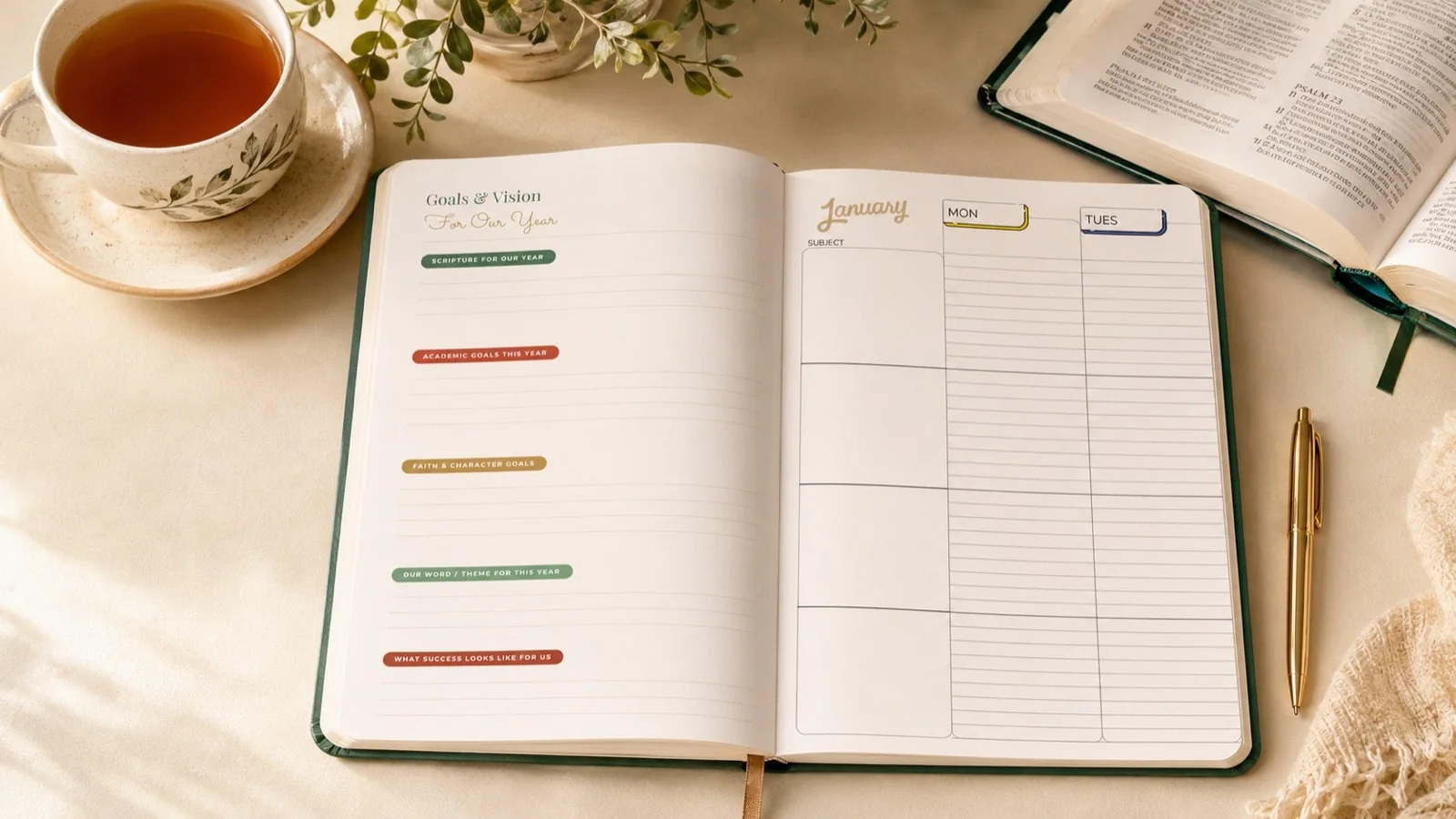
It has to be planned for, which means your planning tools need to hold space for it. A monthly faith focus. A place to record memory verses and prayer intentions alongside your lesson plans. A family vision page that reminds you, on the hard Tuesdays in February, why you chose this in the first place. When faith is built into the structure of your planning, it stops being something you try to add in and starts being something that shapes everything else.
Practical Ways to Stay Organized Through the Year
Here's what tends to make the biggest difference for homeschool families who manage to stay organized and sane through a full school year:
Start with your vision, not your curriculum — before you plan a single lesson, write down what you want your children to know, believe, and be able to do by the end of this year. Academically and spiritually. Let that vision drive every other decision.
Plan in seasons, not just weeks — a yearly overview that maps out your major academic goals, field trips, breaks, and faith focuses by month gives you the big picture you need to make good decisions in the small moments
Colour-code your days by subject — it sounds simple, but visual organization dramatically reduces the mental load of homeschooling. When you can see the shape of your week at a glance, you spend less time managing the schedule and more time actually teaching
Track attendance consistently — even if your province or state doesn't require it, keeping a clear attendance record protects you and gives you an honest picture of how your year is actually going versus how you planned it
Build faith into the structure, not just the schedule — a monthly faith focus, a memory verse your whole family is working on, a space to record answered prayers alongside your lesson plans — these aren't extras. They're the heart of why you're homeschooling in the first place
Give yourself a family vision page — somewhere at the front of your planning, write down your family's values, your homeschool mission, and what you're believing God for this year. Return to it when the year gets hard. It will.
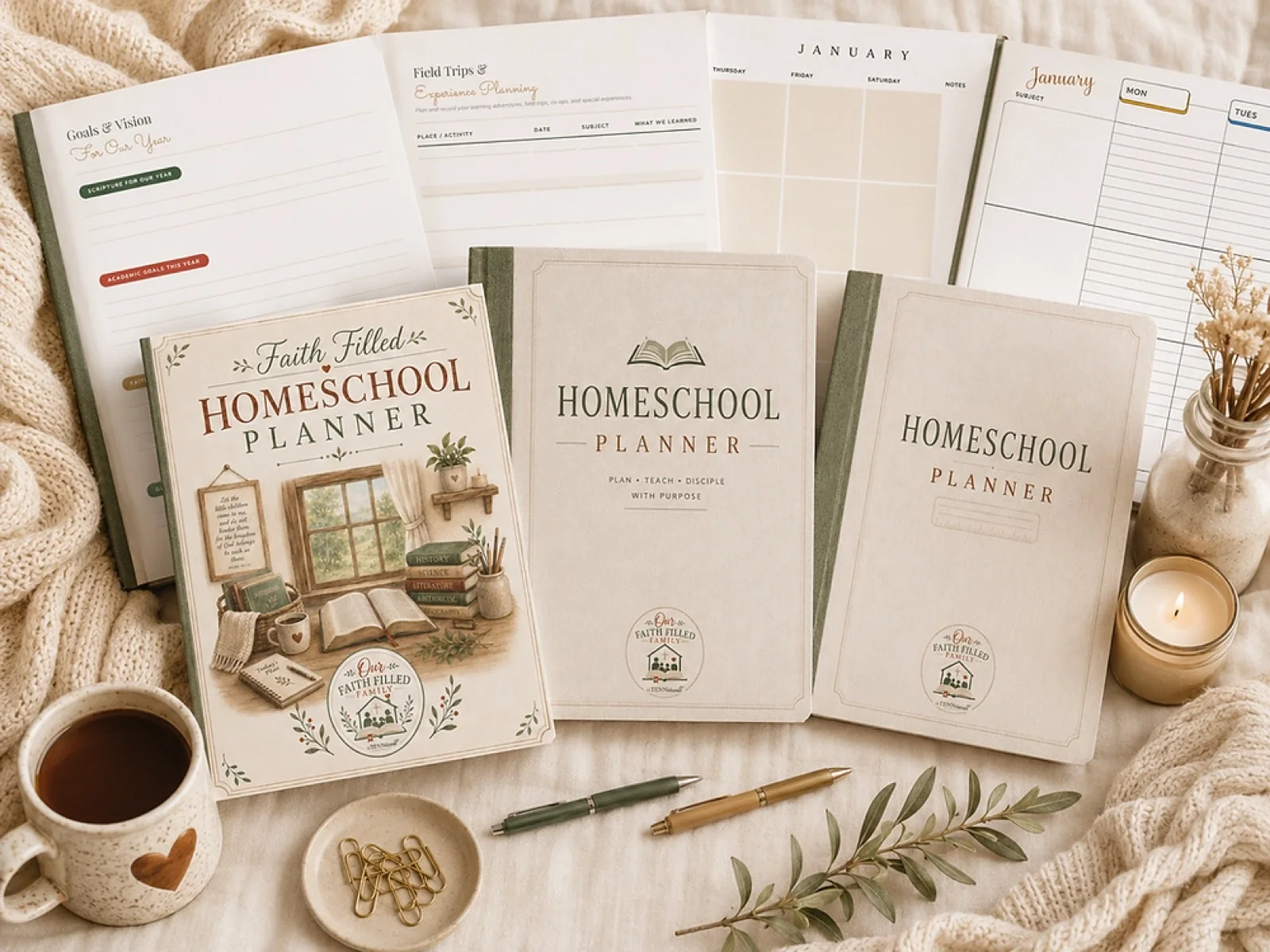
If you're looking for a planner that holds all of this in one place, the Faith Filled Homeschool Planner was built for exactly the kind of homeschool family you're trying to run. It's a 174-page printable PDF with everything you need to plan, track, and anchor your homeschool year in faith — all in one beautiful, cohesive resource.
Here's what's inside:
10 cover designs to choose from, so it actually feels like yours
Two format options — January to December or August to July, depending on when your school year starts
Monthly faith focus pages — a dedicated space each month to set your family's spiritual intention alongside your academic goals
Colour-coded weekly lesson planners — visually organized so you can see your whole week at a glance
Attendance tracking — simple, clear, and built right in
Field trip logs — because those moments matter and deserve to be recorded
Yearly overviews for 2026 through 2029 — plan ahead without needing a new planner every year
A family vision page — the most important page in the whole planner, and the one you'll return to all year long
It's available now for $14.97 — and if you're shopping through Etsy, you'll find it there too.
You Don't Have to Choose Between a Well-Run Homeschool and a Faith-Filled One
That's actually the lie that exhausts most homeschool parents: the feeling that you're always trading one for the other. That if you focus on academics, you're neglecting the spiritual, or if you prioritize faith formation, you're falling behind on the lesson plans. You don't have to choose. When your planning holds both, you stop feeling pulled in two directions and start feeling like the two things you care most about are actually working together. That's what a faith-centred homeschool feels like from the inside, not perfect, or without hard days, but coherent... purposeful... worth it.
You chose this for a reason. Let your planning reflect that.

Want simple, practical ways to bring faith into your family's everyday life? Subscribe to our mailing list, and you'll get instant access to our free guide — 5 Ways to Make Faith Part of Your Family's Week — plus subscriber-only discounts, first access to new releases, faith-filled tools and resources, encouragement and Scripture for your family, behind-the-scenes peeks at what's coming, and simple prompts to help you stay intentional in your home. Everything you need to keep showing up for your family, straight to your inbox.